What we test.
What you learn.
Four tests. Real equipment. Results reviewed by a physician who has run them on himself.
Your watch estimates. The lab measures.
Consumer devices guess at VO2 max using algorithms built on population averages. Heart rate zones come from formulas that were never derived from your physiology. They're useful for general tracking, but they're not the same thing as knowing your actual numbers.
NeverPeak uses clinical-grade equipment to measure what's actually happening in your body at different intensities. The tests below are the ones that matter most for endurance athletes, and together they give you a complete picture of where your fitness is and exactly where to push it next.
VO2 Max Testing
VO2 max is the maximum rate at which your body can consume oxygen during exercise. It's your aerobic ceiling, and it's one of the strongest predictors of endurance performance across every discipline.
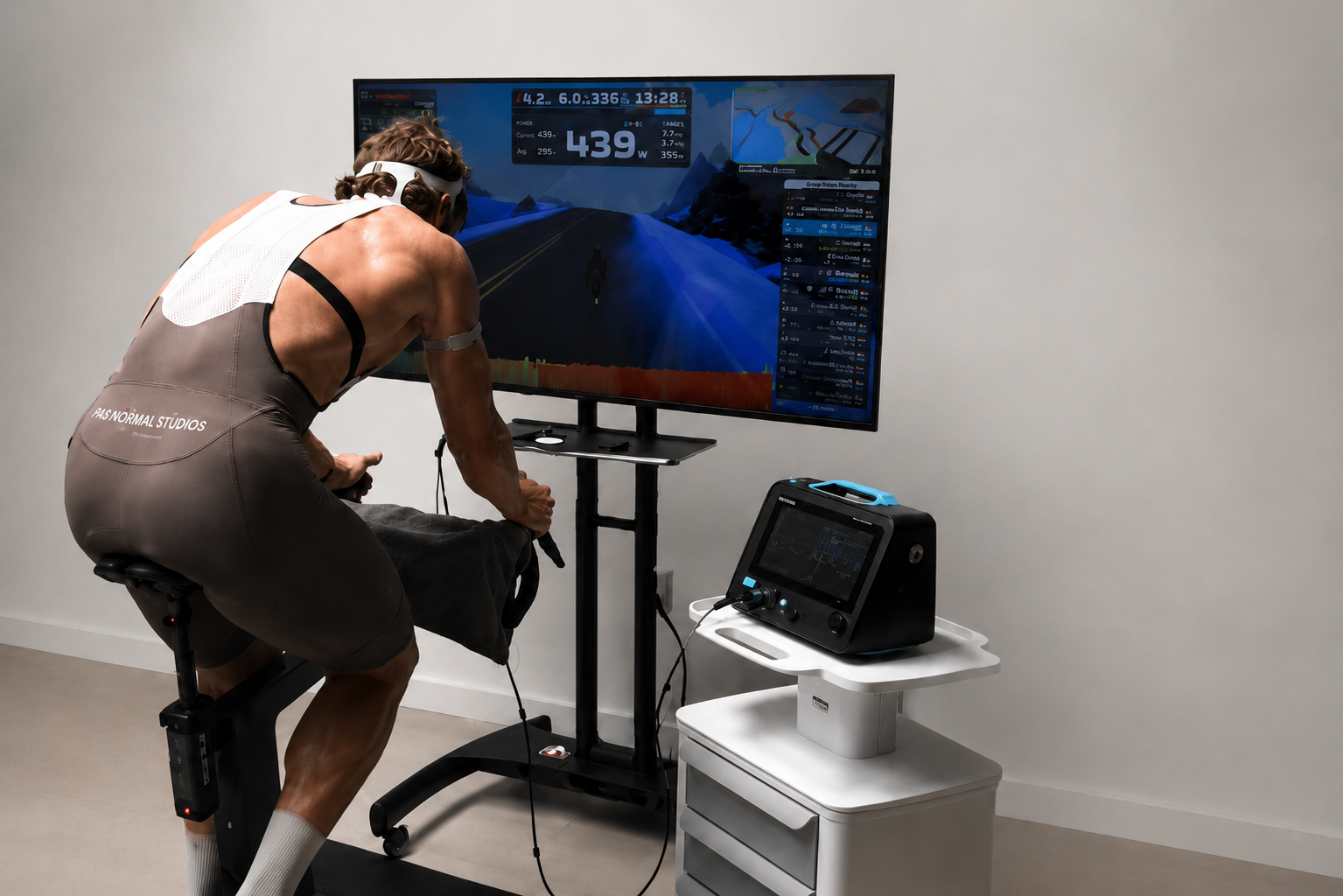
The test uses a metabolic cart and a breath-by-breath analyzer. You ride or run through a progressive protocol while we measure actual oxygen consumption in real time. The result is your true VO2 max, not a watch estimate, and a set of training zones built from that number.
Most athletes who get this done for the first time find their real zones are meaningfully different from what their device told them. Some were training too easy. Some were training too hard. The test tells you which.
Lactate Threshold Testing
Lactate threshold is the intensity at which lactate starts accumulating in your blood faster than your body can clear it. Train below it and you can sustain the effort for a long time. Exceed it and the clock starts ticking.
The test uses a step protocol: we increase intensity in stages and take a small blood sample at each level. The result is a full lactate curve, not just a single threshold number. That curve tells us far more, including where your aerobic base sits, where your threshold is, and how your body responds to increasing effort across the entire range.
This is the test coaches who work with professional athletes use. It's more informative than anything a wearable can produce, and the zones it generates are the ones that drive real adaptation.
Resting Metabolic Rate
Resting metabolic rate is how many calories your body burns at rest, which is the foundation for everything that follows: how much you need to eat on training days, how much to pull back on rest days, how to fuel a long ride or run without bonking or overloading.
The test is simple: you rest quietly while breathing through the metabolic cart for about 20 minutes. The analyzer measures your oxygen consumption and CO2 output and calculates your actual resting burn rate. No formulas. No Harris-Benedict estimates. The real number.
This test is especially useful for athletes managing body composition alongside performance goals, or for anyone whose nutrition plan feels like it's not matching their training load.
Performance Blood Panel
Most athletes get bloodwork once a year at an annual physical, if they get it at all. The standard panel checks the basics but misses a lot of what matters for endurance performance, including markers for iron status, inflammation, hormones under training load, and vitamin levels that directly affect how well you recover and adapt.
The NeverPeak panel is built around what actually shows up in athletes. Dr. Elsbecker reviews every result in the context of your training load and performance goals, not just against a population reference range. A ferritin level that looks "normal" on paper can still be low enough to limit your aerobic capacity. That distinction matters and it's the kind of thing a standard GP visit doesn't catch.
What to expect on the day of your session.
Sessions are by appointment only. The lab is private: just you and the person running your test. No waiting rooms, no shared equipment, no one else watching.
Ready to know your numbers?
Book a single test or ask about packages. Either way, the data is yours.